Money & Investing
The Future Can Win. Investors Can Still Lose.
What the dot-com crash can teach us about AI, retirement savings, dividend stocks, and crypto.
By Allen Bauer · October 22, 2026 · 11 min read
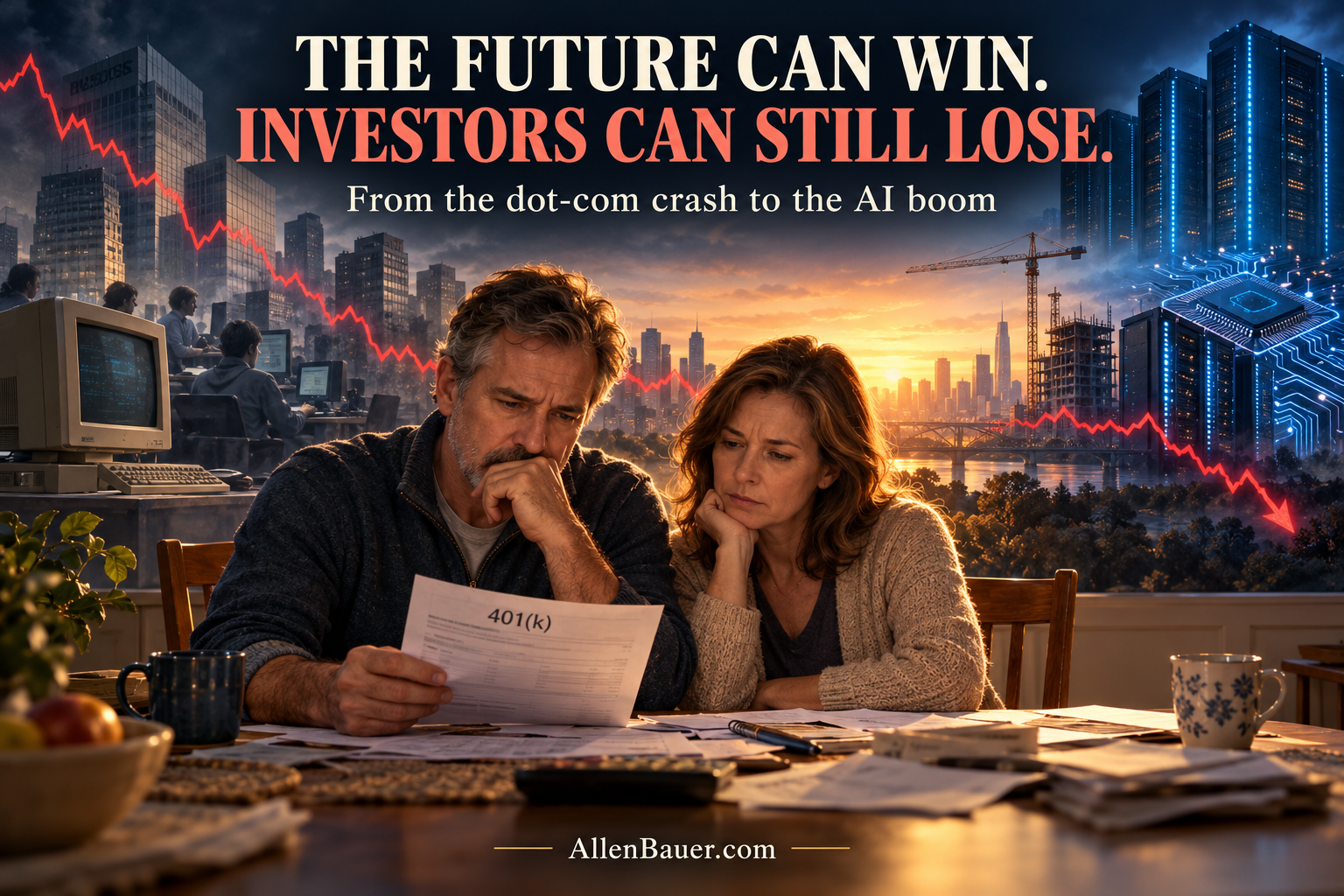
Back in the late 1990s, everybody wanted a piece of the internet.
Put “.com” behind a company’s name and suddenly investors were paying attention. Profits could come later. What mattered was getting in before you missed the future.
And the believers were right about something enormous: the internet really did change the world.
But that didn’t mean every internet company would survive—or that any price was a good price to pay.
When the Future Collided With the Price
The Nasdaq peaked in March 2000. By October 2002, it had lost roughly 78% of its value.
An investment tracking that decline would have turned $100,000 into approximately $22,000, before fees or other adjustments.
Pets.com shut down. Webvan went bankrupt. Other businesses disappeared, were acquired at distressed prices, or left shareholders with devastating losses.
Some survived and became giants.
Amazon endured a brutal stock-price collapse and eventually grew into an enormous business. Microsoft and Apple survived that period and later became vastly larger companies. Google, which was still private during the crash, subsequently emerged as another major winner.
Looking backward, the survivors seem obvious.
Living through it, they weren’t.
Investors didn’t know which struggling company would become the next Amazon and which one would run out of money.
Even owning a future winner offered little comfort if someone lost their job and had to sell it to pay the mortgage.
That is the part of the story I think about when I look at today’s excitement around artificial intelligence.
A Technology Can Succeed While Investors Lose
I use AI. I see its potential. It has already helped me build and create things.
But believing in a technology is different from believing every company connected to it is worth its current stock price.
A business can grow while its shares fall if investors previously paid too much for that growth. A company can survive a crash without its shareholders quickly recovering their losses.
Today’s major technology businesses also differ from many speculative dot-com startups: several have substantial profits and established operations. That matters. It does not make their stocks immune to falling expectations or excessive valuations.
I am not predicting an AI crash. The following is a hypothetical severe scenario—a way to think through what could happen if enthusiasm, spending, and financing reversed sharply.
How the Damage Could Reach an Ordinary Household
Picture a household with two working adults, a mortgage, car payments, some emergency savings, and a retirement account.
They are not day traders. They are working, saving, and trying to prepare for the future.
Then the headlines change.
AI spending is not producing the expected returns. Stocks fall. Companies freeze hiring. A major data-center project gets postponed.
One person in that household loses their job.
Their employer might not even be a technology company. It could supply electrical equipment, handle construction, recruit workers, or provide services to businesses cutting their budgets.
The household stops eating out. Cancels a vacation. Puts off replacing a car.
Now the restaurant, hotel, and dealership have fewer customers.
Those businesses cut hours or delay hiring. Some eventually lay people off.
That is how trouble travels from a stock-market story into the broader economy.
If heavily indebted companies default and lenders become more cautious, the damage can spread further. Healthy businesses may face tighter financing at the same time their customers are spending less.
The Retirement Account Gets Hit Too
A 401(k) is an account, not a guarantee against losses. The investments inside determine its exposure.
Suppose a $500,000 retirement account falls 40%. It is now worth $300,000.
A 50% decline leaves $250,000. Recovering from that loss requires a 100% gain, assuming there are no withdrawals.
These are illustrations, not forecasts.
Now imagine losing employment income at the same time.
Emergency savings eventually run out. The mortgage, groceries, insurance, and utilities keep coming.
The household begins withdrawing retirement money after its investments have already fallen sharply.
Withdrawals from a traditional pretax 401(k) generally count as taxable income. Before age 59½, an additional 10% early-distribution tax may apply unless an exception covers the withdrawal.
Losing a job alone does not automatically waive that additional tax. One important exception can apply to withdrawals from an employer’s plan when separation occurs during or after the calendar year the employee turns 55. That exception generally does not apply to IRA withdrawals.
The household could face lost wages, investment losses, taxes, and possibly an early-withdrawal penalty together.
The money withdrawn also will not participate in a subsequent market recovery.
That is why “just hold until it comes back” can be much harder in real life than it sounds.
Which investment comes back? How long does it take? Can the family afford to wait?
An index can recover while individual companies disappear. Markets can rebound while households are still rebuilding their finances.
Where My Dividend Stocks Fit
The holdings currently listed on my dividend page are EPD, MO, MPLX, AMSF, GLPI, and VICI.
These businesses involve pipelines, tobacco, insurance, and real estate. Their investment cases do not depend directly on selling the next AI breakthrough.
That does not make them crash-proof.
During a panic, investors often sell what they can. My holdings could decline substantially alongside the broader market.
A recession could weaken customers. Financing could become harder to obtain. Tenants could struggle. Business performance could deteriorate.
I also have concentration to consider: two pipeline businesses and two gaming-property landlords. Six holdings do not represent six completely independent sources of risk.
What interests me is the possibility of continuing to receive cash while market prices are down.
If these businesses maintain healthy cash flow and sustainable dividends or distributions, I can receive income without selling shares or units simply because the market has fallen.
If I reinvest those payments, lower prices allow the same amount of cash to purchase more shares or units.
But the sustainability of the payment comes first.
Could Dividend Stocks Recover Faster?
They could, particularly if investors turn away from expensive growth stocks and toward established earnings, sustainable income, and more modest valuations.
Some might decline less in the first place. Falling interest rates could also help certain income investments, depending on their debt, business conditions, and other factors.
There is no guarantee.
A dividend cut, refinancing problem, tenant failure, or damaged business could leave an individual holding struggling for years.
A high yield is not proof of safety. Sometimes it is a warning that investors expect the payment to be reduced.
There is also a difference between recovering the quoted share price and recovering an investor’s total value. Cash payments received along the way contribute to total return.
Dividends are not free money that cancel out losses. They are one component of investment returns, and future payments depend on the business.
For partnerships and REITs, cash-flow measures appropriate to their structures can be more informative about payout coverage than earnings per share alone.
What About My Crypto?
I own crypto too. I would not assume it would protect me during a stock-market panic.
Bitcoin, XRP, STX, and other crypto assets could fall sharply as investors raise cash and leveraged positions are liquidated. Smaller or less liquid tokens could suffer even more.
Believing in a project’s future does not prevent someone from selling it to pay their bills.
Crypto could rebound strongly if financing conditions improve and investors become more willing to take risks. That does not establish when—or whether—any particular asset will recover.
The dot-com era offers a useful reminder: a technology can have a future without every business or investment associated with it having one.
Owning stocks and crypto does not automatically protect a portfolio if both decline together.
What Else Could Fall?
A severe downturn could spread into bank and lending stocks as defaults increase.
Retailers, restaurants, airlines, hotels, and automakers could suffer as households reduce spending.
Commercial real estate could weaken if vacancies rise and financing becomes more difficult. Residential property prices could fall in communities experiencing significant job losses, although local conditions would matter enormously.
Industrial commodities could decline if manufacturing and construction slow. Oil could fall with weaker demand, though supply disruptions could push prices the other way.
Lower-quality corporate bonds could lose value as investors demand greater compensation for default risk.
These are possible channels, not a prediction that everything would decline together or by the same amount.
What Might Hold Up Better?
U.S. Treasury bonds could attract investors seeking safety. Existing fixed-rate Treasury bonds generally benefit when market yields fall, but longer-term bonds can lose value if yields rise instead.
Gold could benefit from demand for safety, although it can also be sold during an initial scramble for cash.
The dollar could strengthen if global investors seek dollars, depending on the origin and nature of the crisis.
Businesses selling everyday necessities might prove more resilient. Holding up better could mean declining less rather than rising.
Cash, insured deposits within applicable coverage limits, and short-term Treasury bills could preserve spending capacity and provide funds for future purchases. Their interest income could decline as rates fall.
No asset guarantees protection against every combination of recession, inflation, and financial stress.
The Ability to Wait
The person with manageable debt, accessible savings, and dependable income has more choices than someone forced to sell investments after a major decline.
That flexibility matters.
My approach is not based on believing my dividend stocks cannot fall. They can.
My crypto can fall too. A dividend payment does not make a business immune to financial trouble.
I want to understand the companies I own, assess whether their payments remain sustainable, and maintain enough flexibility to avoid selling simply because life and the market both turn difficult.
The dot-com crash did not stop the internet.
An AI crash would not necessarily stop AI.
But a technology can change the world while the bubble surrounding it destroys people’s savings.
I want to participate in the future. I also want a plan that can survive a difficult road getting there.
Don’t eat the chickens—but make sure they are healthy, and keep enough feed to get through a hard winter.
— Allen
This article discusses hypothetical scenarios and my personal investing approach. It is not a market forecast or individualized investment or tax advice. Investments can lose value, dividends and distributions can be reduced or eliminated, and recovery is not guaranteed. Holdings may change.
← More articles